Showing posts with label Phase Transitions. Show all posts

Saturday, February 2, 2019

Should physics/maths graduates be worried about maths/physics graduates?


Theoretical physics is such a great field because people from lots of different academic backgrounds can transition into it! Fields that might seem far removed like computer science, engineering and even biology can often lead into theoretical physics. The main two sources of theorists are maths and physics graduates, this can sometimes be a source of worry for both cohorts, I know maths graduates have worried me in the past and still do! 

Lets talk about the concerns these two groups might have about how each other could have an advantage over them. After that I hope to at least reduce your worries, whether you are a physics or maths undergraduate. I'll also offer some advice to those of you who are approaching theoretical physics from a subject a bit further away than maths or physics.

Concerns of Physicists:

Lets start with something I know well, fear of mathematicians! I think a lot of the fear physicists have of mathematicians comes from the Cambridge Part III and the number of successful theorists that have come from that maths course. The study of high abstract topics like string theory, super-gravity, super-symmetry and similar topics is seen as being more akin to pure mathematics than physics sometimes. They deal with very generalised situations and use a language not featured in a large proportion of undergraduate physics topics (if any). 

Mathematicians often receive in depth training in subjects like topology and differential/algebraic geometry to a high level. These are linked heavily with subjects like string theory and general relativity, so such training is often seen by physics graduates as being a point of weakness on their part.

Furthermore, mathematicians spend a lot of time studying proofs and the art of proof, something physics students definitely DO NOT spend much time on it if any. The impression given is that theorists spend a lot of time proving things and as such physics students get nervous about their lack of experience with proving in a mathematical context.

There can also be a general atmosphere that mathematics is a trickier and purer subject than physics. I have had the idea that maths is superior to physics impressed upon me more than once, it does certainly get you down. Feelings of academic inferiority don't help the previous matters.


(Image Credit: A Growing Physicist)

Concerns of Mathematicians:

Now not being a mathematician, this is not personal experience I'm drawing on but comments from academics, students from both disciplines and some general logic and know how about maths courses.

Mathematicians are not always trained in advanced classical mechanics. This can appear quite the weakness when compared to physicists who are often trained quite well in the Hamiltonian and Lagrangian formalism by the time they finish their degree! This can be perceived as a weakness when beginning the study of field theory but in reality it is something a mathematician will pick up very quickly.

Physicists have often studied very specific (and highly relevant topics) like particle physics and electromagnetism. Mathematicians might be concerned that they haven't covered the standard model in qualitative detail or Maxwell's equations in depth. Special relativity also comes up, like electromagnetism this is not something necessarily covered in a maths course and a highly relevant topic to many areas of theory.

A more general skill physicists utilise is the contextualisation of mathematical results in a physical setting. Mathematics often does not focus on this, it maintains a more abstract setting (which itself can be perceived as a strength of maths students vs physics students) so mathematicians may fear that lacking experience of this leaves them at a disadvantage.

Like physicists, there can also be a feeling of academic inferiority though for my money I think this affects mathematicians much less. But it does happen, some mathematicians talk about theoretical physicists like they are scary people!
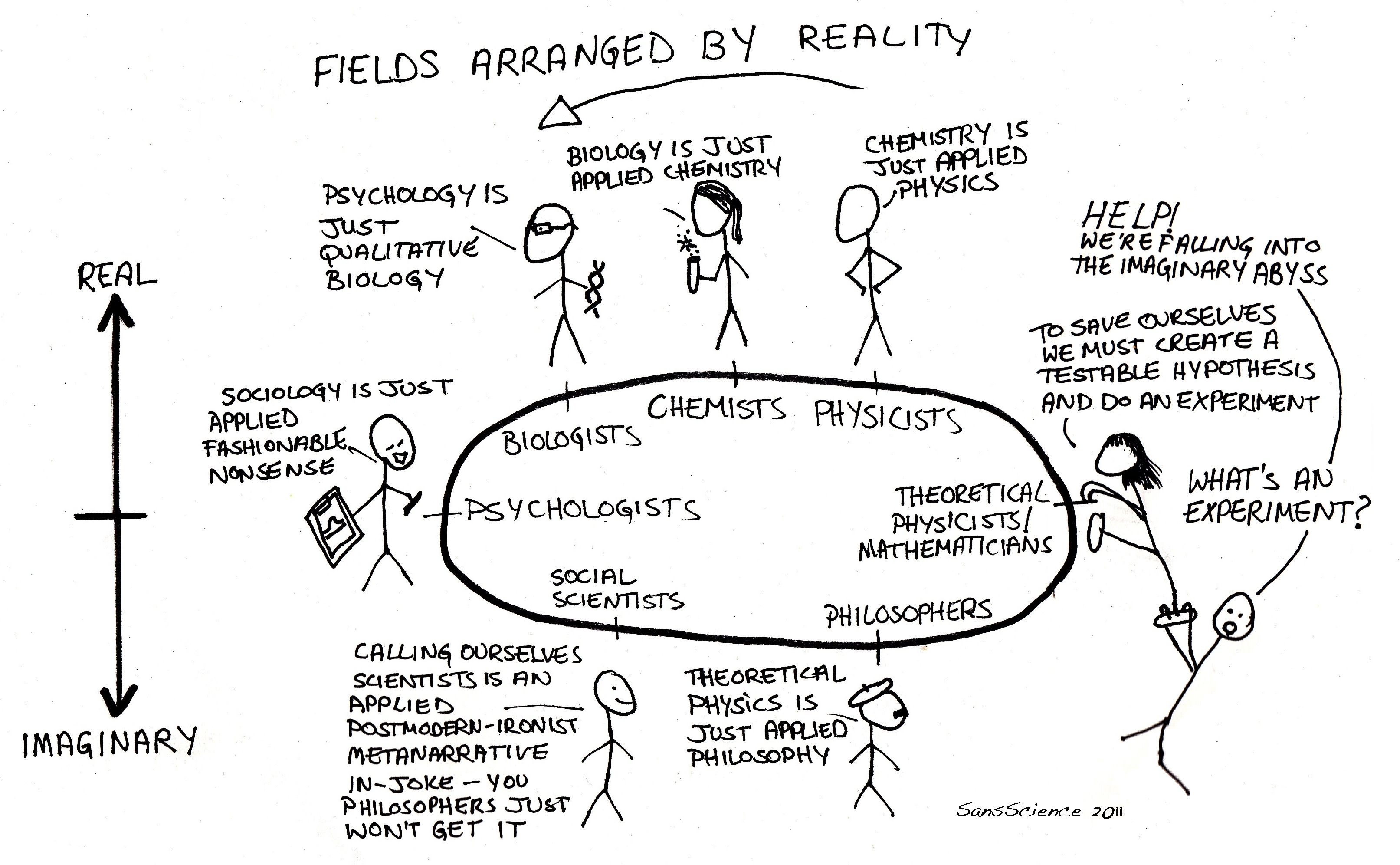

Image result for mathematics vs physics
(Image Credit: WordPress)

Addressing concerns...

Firstly... you might notice that each side has plenty of perceived issues. So even if my proceeding comments don't offer you some peace about your perceived disadvantage, know that the 'other side' (for want of a better term) probably have a similar number of completely different deficits to your skill sets. I touched on this when talking about going to a 'non-perfect' uni, everyone, no matter their route, has advantages and disadvantages.

Furthermore, the primary skill you learn in a degree is to, well, LEARN. You can learn skills from maths and physics whichever camp you are approaching theory from. The subjects are not miles apart in the grand scheme of things either, mathematicians and physicists have the closest of languages in comparison to other academic fields. It is not hard for mathematicians to get acquainted with the physical context and interpretation commonly associated with skills acquired through studying physics. Likewise as a physicists you use maths all the time, it isn't hard to pick up a book on topology and starting learning it and the more generalised, proof driven structure of mathematics.

As this cross-over becomes more and more prominent, courses inevitably react as well! Mathematics courses these days often offer modules in quantum mechanics, physics courses also have more advanced maths modules. These supplement perceived weaknesses and can help prepare you for a career in theoretical physics.

I myself took a 'Further Mathematical Methods' module in my 3rd year. It involved studying complex analysis, linear algebra and basic group theory. After this I felt much better equipped to begin venturing into the world of mathematics for theoretical physics.

From my perspective the best thing you can do if you are in the midst of your degree is to (as always) take relevant options to your career path. If you're doing a maths degree take quantum mechanics options, if you're doing physics then take some higher level maths options. Asides from that, don't worry! Both sides have initial weaknesses but these disappear with further study.

With regards to feelings of inferiority, maybe comparison is just a silly idea. Both fields have their own methods and goals, own strength and weaknesses just as their students have. 

From my own experience, the criticism levelled at mathematicians by physicists is that their work is too abstract and inapplicable. Any physicist who says this is doing their own field a disservice, development of the language and techniques that physicists (and all scientists) work with on a daily basis is a purely positive thing. No group theory... no standard model, no crystal structure study, no cryptography etc.

Physicists can sometimes get the vibe from mathematicians that their work is not a 'pure' as theirs. This notion of purity and beauty is (sorry to be such a scientist here but) not as yet a measurable quantity. The 'pureness' of a subject is nothing to be concerned about. 'Yes but you haven't proven it in a self contained manner' (to para-phrase), its an irrelevant statement. It's not what physics is about, in the same way that pure mathematicians rarely spend time on applying their work to real world problems, and both of those aspects are ok. And lets not forget that sometimes physicists end up developing serious developments in mathematics (string theory cough cough). 

Theorists and mathematicians especially are very close in reality these days so its best not to be comparing ourselves to each other. We should worry more about defending ourselves to the sciences that are do immediate good for the world and explaining why we are still needed!

(Sorry for that rant...)

What if you studied theory and want to go into maths?

This is possible, though I think it's harder than transitioning to theory from maths. If you have covered sufficient mathematical content then it certainly can happen! What I mean by this is by studying GR you can gain experience in differential geometry for example. If you've focused on more numerical topics you might find applied maths fits well and if you've focused on the abstract purer mathematics will probably appeal to you more. Again maths and theoretical physics can be almost indistinguishable at certain boundaries, as a result transitioning from physics to mathematics is not unheard of. But as someone interested in this myself it's not easy to demonstrate you have the pre-requisites to do a PhD in geometry for example. This is only fair though, it's very unlikely that a maths grad would get on an applied particle theory PhD, that's a very real career option for someone like myself.

What if I'm further away from physics than that?

I'm not going to push an illusion here, you would be in a very exclusive (potentially entirely exclusive) group if you managed to do a degree in biology and then end up doing a PhD in say string theory. But for a lot of subjects that might seem a bit further away from theoretical physics, you might be surprised at the areas available to you. Mathematical biology and biophysics are two areas that come to mind when considering moving from traditional biology to a more physics-y direction. Did your degree in geology? Try geophysics. Computer science? Have a look at quantum information and the sub-branches of that. There are a large number of fields like atmospheric physics, physical chemistry and nuclear engineering that can definitely take a theoretical physics perspective. Not all theoretical physics is string theory, in fact most of it isn't!

So whilst I make no promise that anyone/everyone can get a slice of particle theory, I think there are plenty of opportunities for you to get a piece of the theoretical physics pie if you are coming from a different area of science. Sorry English students... I don't think you'll be able to re-specialise this drastically unless you're the next Witten. The key thing is to like (and ideally be good with) maths. Programming is always useful as well.


There you have it, my reasoning for not being afraid of your academic counterparts in other fields within the realms of theory. Ultimately its best to focus on acquiring knowledge and skills and then mastering them. This will put you ahead of your competition, not the nuances of the field you studied.

Is theory worth the odds?


Whilst it might not be pleasant to think about, the fact is there aren't many theoretical physicists in the world. Even worse is the comparison of the number of physics undergrads to the number of theoretical physics academics (a more useful comparison). Unfortunately I can't quote a specific number, but needless to say it will be very very small.

So is it worth it? That is, will the repeated applications, potentially to Masters, then PhD, then postdoc, then trying to work your way up the academic food chain till you gain a (reasonably) permanent position be worth a job in theory? Fighting for funding all the while, almost certainly having to teach in one way or another (good thing for me, but might not be your cup of tea) and compromising on your salary potential. Is it worth it?

I preface this with a warning, the whole post might seem like me listing off a load of reasons not to pursue theory but that is really not my intention. I would encourage anyone and everyone to go for a career in theoretical physics academia! But it's important to know the difficulties of getting there, I've tried to offer advice when I think there's something useful to be said, but this is more about what you'll be getting yourself into if you want to become a theorist...

PhD application odds:

It's no secret that PhDs in theory are not readily available. This statement can be much more relevant to you depending on what area of theory you're looking at, more on this later. Due to the lack of places you're likely to encounter the following problems.

High entry requirements: Just because the advertised entrance is 2:1, for many universities the chances are successful applicants will have a 1st. This not to say that if you don't get a 1st you can't do a PhD, not at all. It just means that you will be more limited and ultimately sport a less competitive application. For many people this seems unfair, but you have to bare in mind that for theory the skills they need you to have are difficult to measure without exams in the current system. Check my article on how to set yourself apart when studying theory for some things you can do outside of exams that might help you.

Now the most obvious but hardest answer to this problem is do as well in your exams as you can. If you can get a 1st, that would be ideal. But there are always complications in exam season, so what if you get a 2:1? Well there are plenty of PhD programmes that will take 2:1s, you might have to fight a bit (by which I mean write a kick-ass application and try and add some extra stuff on your CV like placements an such) but a good number of people get into theory PhDs with a 2:1. 

If you get a 2:2, in my personal opinion its unlikely that you would get onto a theoretical physics PhD. Please give it a go if you want to, but I wouldn't want to give an illusion of inflated odds. But that doesn't mean you can't do a PhD in a related field, to some this might sound like a cop out, but I think its a perfectly valid route and one that can be very rewarding.

Funding problems: You might get a PhD place... but is it funded? As an example, Imperial has funding for maybe 4 theory doctorates a year (at most). That's tiny. Some of you may be aware that the government has introduced a doctoral loan, but I would advise you not to use this in place of funding. Asides from that fact that the numbers don't really add up, I would strongly advise you to only do a PhD if it funded. There are many reasons why I believe this is the case but I won't discuss those here. One exception I can think of is if you gain a substantial graduate scholarship (like the ones offered at Oxford). 

You should also be aware that funding is often for 3.5 years, it is not unheard of for theorists to take considerably longer than that to complete their thesis. This would inevitably cause financial concerns if you aren't on track to complete within the funding window.

So what can you do about this? The main thing is to apply for full funded PhDs on topics that you are suited to. This insures financial security and if you are suited to the topic you would (hopefully) be more likely to complete the PhD on time. Funding is a difficulty all members of the theoretical physics academic system face, I don't see this changing anytime soon...

Getting the right PhD: When you apply your specific interests as a filter to the small puddle of theory PhDs you will probably be left with a droplet! You simply cannot avoid this as its absolutely essential you find a PhD that interests you. If you have broad interests, that's great. If you're like me and you only want mathematical physics and don't like phenomenology then things can become really quite tricky...

Some comments: So in essence the problem is that getting on a funded theoretical physics PhD that is on a topic you enjoy is not going to be a piece of cake. That's no reason not to give it a go. There's no denying that applying for PhDs can be incredibly stressful, but the pay-off can be amazing. The best thing you can do is try and do well in your exams and don't pick one you don't like or an unfunded one.

Scarcity of postdoctoral positions:

So even if you get on a theory PhD, the number of postdoc positions awaiting the years PhD cohort isn't large enough for everyone to get a job! This is a fact theorists especially have had to face of late. It's also a reason why you should only take a funded PhD, chances are if your PhD wasn't funded you won't have a shot at a postdoc position.

There are implications of this narrowing of the funnel...

Where you do your PhD matters: I wish I could say otherwise, but on balance of probabilities if you did your PhD at Surrey and you're up against someone who did theirs at Oxford you would be at a disadvantage. I'm not having a go at Surrey as a uni (it has a really good physics department) but relaying my assessment of the state of the perceived academic hierarchy at present. There are several reasons for this bias. 

Inevitably there is some bias of academics towards universities of higher repute, whether you see this as valid or not is besides the point, it is there. Somewhere like Oxford also has more funding and more pull within the scientific community, this has several implications. Your PhD research is more likely to reach further if you go to a better known institution, this is certainly beneficial when applying for postdoc. Also previous members of universities like Oxford/Cambridge dominate theoretical physics departments across the UK. They maintain links with Oxbridge and some of them have a preference for Oxbridge graduates, even over those who complete PhDs within their own department.

When I have spoken to theorists about career prospects they always said that what mattered most was the institution I did my PhD at. I'm not saying if you don't do your PhD at Oxbridge you've got no chance, but I'm under the impression it could help a lot...

What you do your PhD on matters: A little preface here, a lecturer of mine told me last year that trying to predict what topics would be 'in' by the time you finish your PhD was an absolute waste of time. I stand by that completely so take what I'm saying with a pinch of salt.

The most important part of this is that have to LOVE the topic you are going to research in your PhD. This gives you the best chance of producing good research that will be noticed by the scientific community because you will have maximum motivation to keep working hard. It also means that if you can't get on the postdoc ladder, you won't see your PhD as a waste of time. If you have a very specific idea of what you want to do, go with it. If you are a bit more open, you might want to consider the following...

If you are 50:50 stuck between string theory and particle phenomenology, you really like both, you might want to consider which one gives you better career prospects. In that case you would go for phenomenology, it has much more funding available and string theory is currently under stress. If you wanted to research formal string theory later in your career, this wouldn't be a hard transition and you'd be much more likely to get a postdoc in phenomenology than string theory. This is only for those who don't have a specific idea of what they want, I wish I liked phenomenology (who knows, maybe I'll change my mind over the next few months, it would make my life a lot easier) but I know its not right for me so I won't try and spend 3-4 years researching it! This can get even more specific so try and get a good idea of where the field is heading.

Some comments: It is key to realise that getting on a PhD does nothing to guarantee you a career as an academic. The best thing you can do is to pick a PhD that you love and then if you don't get into academia afterwards you'll still have loved the time you spent in research. It is also important to be aware of time scales, you may not immediately move from PhD to postdoc, you might have to work in industry for 6 months for example. Also bare in mind the reputation of the institutions you're applying for, they matter more than they ever have before. 

Difficulties in getting a permanent position:

This is a really important one to be aware of if you are seriously thinking about academic theory. Most academic positions these days are temporary, at least the kind of positions you'd be looking at for the first 5-10 years of your career after PhD. Some star theorists land professorships in that time frame, but that is certainly not the norm! Most departments work on 2 year contracts, forcing you to either fight to renew your contract, move up to a higher role in the same department or find a position at another university. 

This uncertainty and movement is something that will work for some and not others. What may not work for anyone is the potential to be left without a salary and no redundancy package to support you after that contract ends. It is a risk you should be well aware of when considering this career path. The path does lead to permanent positions but how long this takes is not set. Your progress is very dependent on your research and ultimately there is no way of predicting the quality and amount of research you'll produce in what time frame throughout your career. 

Dependence on funding:

Alongside the temporary nature of positions, academics have a continuous battle for funding. This involves a heap load of applications, presenting to panels and more in the continued fight for your academic livelihood! This is another level of uncertainty that would affect you in a number of ways.

Perhaps the most important is that your research capabilities may be directly impacted by your funding. This means you'll be fighting for resources that would enable you to carry out the research you're so passionate about. This is very different from say industry where often scientific researchers are provided with any resource they need! 

This has further impact, if there is a lack of funding, your research quality may decrease and subsequently you may be denied funding again. And so a vicious cycle may begin...

Furthermore, you may be fighting for group or departmental funding, this places the funding of colleagues under your responsibility and your success or lack of would not just impact you but potentially many others. That is a serious responsibility that could land in your lap if you take on a more senior academic role, you should be aware that this could be something you face one day. As mentioned above lack of funding can have serious long term consequences...

Teaching responsibilities:

There are no theoretical physics research institutes in the UK, so you would have to take up a research post at a university. For almost all of these you will be required to teach in some form. This could be lab supervision, lecturing, PhD supervision etc.

For some the prospect of teaching is enjoyable and a key part of being a scientist, for others they see it as getting in the way of their research. I'd advise you to convert to the former if you are currently in the latter. Some academics don't have teaching responsibilities but that is a small group and is especially true in theory.

The lure of other jobs and the question of money:

Having any level of qualification in theoretical physics from degree to PhD gives you serious (and I mean serious) career prospects outside of academia. Finance, defence, consultation, energy, data science, software engineering... in fairness not all of them considered savoury professions.

These are often (in comparison to academia) easier to get into than to carry on the path of theory. They also have more set career paths and perhaps most alluringly, more money...

Money vs your real passion is not a new question. Its especially relevant for theorists because they can earn A LOT of money outside of their real passion. Those who don't make the transition from PhD to postdoc often end up in very well paid jobs (this is another good reason to do a PhD regardless of your postdoc chances). You simply have to ask which matters more to you, but if you go into academia you should feel safe in the knowledge that well paid work awaits you outside academic research.

Choice of field:

Its important to know that some fields within theory are significantly more competitive than others. For example condensed matter theory PhDs often have a 2:1 entrance whereas particle theory PhDs often (basically always) have a 1st class entrance requirement. There are also far more postdoc opportunities for condensed matter theorists than particle theorists. This is something to be aware of if you undecided as to which direction to go in, there are certainly easier routes than others. Bare this in mind if you don't have a particular direction in theory you're passionate about.

Closing comments:

I hope that hasn't put anyone off pursuing theory, my intention was to make people aware of the difficulties associated with the career path and to offer some relevant advice. These challenges do perhaps ensure that you are truly committed to the career path, you absolutely have to be if you want to succeed in this business.

Monday, October 15, 2018

Projects/research modules vs taught classes


Whilst I was looking at masters courses at the beginning of last academic year, I spoke to two particle theorists about the advantages of taught and research components of a masters course. Instead of gaining clarity I was actually given two completely different answers! Here's what they said

The first academic told me that if he was looking for a PhD student he would value more extensive research experience. His background was in developing more precise calculation methods for particle collider experiments, specifically the LHC. He had done his undergrad in Germany and PhD in the US. His view point was that the best way to show you were ready to undertake a serious research project was to do a bit of research! Which makes sense right? As a student it would also give you confidence to have dipped your toe in the water before you dive in, surely?

The second held the opposite opinion. He suggested that having a large taught component was crucial as for particle theory understanding field theory well was something he would need a prospective PhD student to have. Such extra knowledge was crucial for getting into a theory PhD. He also had some interesting points about research projects. He pointed out that a research project is worth very little to an admissions officer as it's not complete. In the case of masters courses especially, the chances are you won't have even started your research project by the time the PhD cycle is finished. So it was better to have on your transcript that you were set to take a large number of high level courses, that would demonstrate your competence. This... also makes sense.

In an ideal world we want to take loads of high level courses whilst also embarking on a large ambitious research project which we can have evidence of by the time we are applying for a PhD...

There is a name for this. It's called a theoretical physics PhD!

So unfortunately for us we have to make a decision and it is most certainly not clear cut. I'm going to try and pick apart the above opinions and throw some of my own experiences and opinions into the mix. With luck, this will aid you in making a decision about what kind of course you want or what choices you should make on your current course.

It depends on what field you want to go into
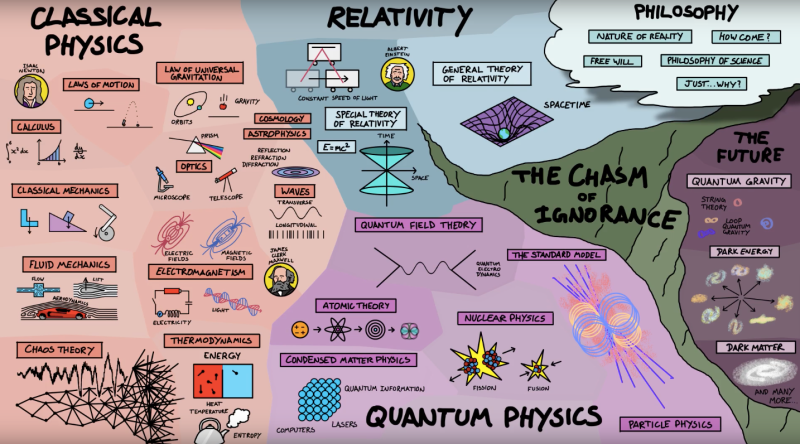
The two academics might have both come from particle theory but they did very different things. The second lecturer worked on astroparticle phenomenology, developing new models to provide dark matter particle candidates for example. This is a less 'applied' area than the first lecturer's research topic.

Image result for map of theoretical physics
(Image Credit: Domain of Science)

The more applied theorist wanted research skills and the more abstract one required higher level topics to be covered. This is often the case, to get into condensed matter PhDs for example doesn't always need a masters for instance! Different fields and areas within those fields have certain skill requirements, after you have fore-filled that they would like you to fill your remaining course credits with research based activities. For highly theoretical topics like string theory, quantum gravity etc. a project is in some academics eyes not remotely useful. The Cambridge Part III doesn't feature a project and is (probably) the most common route into such topics.

So making an assessment of the field you would like to go into and how high the skill level required is could be key for you making a decision. It is also a good idea to ask the most relevant academic you can talk to, for me I'm interested in topics closer to the second academic than the first so I weighted his opinion more in my decision making.

It depends on the types of institutions you're applying to
This isn't exactly a concrete/objective observation, but I think it's worth considering. Some institutions (i.e. Oxbridge) would be associated with preference to a larger number of high level taught courses, this is certainly suggested by the masters courses they offer. Sussex (disclaimer: a university I applied to for masters and received and offer from for Particle Physics MSc) is a university who's postgraduate courses have a large research component, I would expect them to like applicants who have done sizeable research projects.

This is a sweeping statement but... Universities with a public 'reputation' typically prefer taught courses and 'research focused' universities typically prefer research projects. I do not mean 'good uni's' like taught courses and 'bad uni's' like research modules' not at all. What I have in mind is that a great uni like Southampton doesn't expect you to have a masters in their entry requirements for PhD, so demonstrating research skills in your masters may well be more useful than taking loads of taught courses. Conversely a more 'traditional' uni like Durham would probably prefer taught courses for their PhD. This is not even a rule of thumb, just something I feel I've noticed in researching masters courses and PhD programmes.

I can't comment on institutions outside of the UK, I just don't have the experience or knowledge to provide good advice.

Which one are you better at? Which one do you like more?
A simple but crucial question. If you're lucky enough to be great at both, well done, but I don't think that's usual. Myself for example, my highest grade at undergraduate was my 3rd year project. So I guess I should have chosen a masters with a large research project! But that doesn't suit my PhD topic of interest so I chose a primarily taught course. However, grades are crucial for PhD admissions so if there could be a difference in what classification you achieve depending on the balance of taught vs research modules consider the implications seriously.

Alongside this, you should be enjoying what you're doing! If you prefer research take a more research heavy course, your enjoyment will probably enhance your grade.

Research projects are good learning experiences
I learned A LOT from my third year research project. I learnt a lot about what theory was not and stuff that theory was that I had no idea about! There are things that research can teach you that I think you really can't learn from standard physics courses. You might have experienced this you have/had to take lab classes in your first (potentially second) years. Even as a theorist you might find something like fitting a curve to data using Python or interpreting and applying an equation to data reveals new things to you in this 'research' situation because you have lots of time to play around with the ideas and apply them broadly. 

Now this probably isn't a reason to alter the size of project you want. But it is an incentive to choose a masters with a research component (i.e. not the Part III) or to take some research components in your degree if you have options in that regard.

Is a compromise worth a uni you're chasing?
So you want a big research project but you just got an offer from Oxford... yeah, dilemma. Oxford is maybe a bad example because grabbing that level of prestige that could carry you far in a PhD admissions process. But my point is that the contention of 'dream' uni vs better suited course structure happens. 

In all honesty, your decision should be based on what you think the best suited course is. Try to remove your preconceptions and personal alignments, choose the course with the best looking modules and course features, taking teaching quality into account if you can as well.


There you have it, I hope that's useful for anyone facing decisions regarding research and taught modules.

Sunday, October 7, 2018

MSc vs MSci


MSci is quickly becoming *the* route for physicists from all walks, whether you be aiming for industrial or academic research. Despite the fact that almost all those in my cohort who were aiming to become theorists went with the MSci programme, I choose to leave after three years with a BSc and do a separate MSc. In the interests of fairness I'd like to first argue (quite generally) why I (or you) should follow an MSci programme. After that I'll explain my reasoning for doing an MSc and why I think for some people its a better option.

General Outlook

There's no doubting a serious advantage of the MSci is that you are fully funded for tuition fees and provided a maintenance grant for your fourth year. You don't have to make a new funding application or apply for a new course either! Whilst these might just seem like simple practicalities I can't deny that the process of applying for a masters course was stressful and that the fact that my funding only covers my tuition fees is difficult!

There's also the continuity of your study, you maintain friends and links with academics for longer. If you're on the University of London intercollegiate programme this won't be the case so much but for all other MSci programmes you'd certainly benefit from this. 

Many programmes also have research skill modules structured throughout the third and fourth years for MSci students, this is something you would likely miss out on if you do a BSc followed by an MSc. In general universities recommend MSci programmes rather than MSc programmes. The good reason for this recommendation is that the MSci is being developed as *the* route into PhD.

Now here's my caveat. I think the MSci is probably the best route for most physicists, except in the following cases:

  • You don't like your current university for genuinely good reasons and want to study somewhere else.
  • You feel you need to study at a more reputable university to improve your chances of achieving your career goals.
  • Your university doesn't offer modules on the masters level subjects you want to study or/and doesn't go to a high enough level of study for the career you are pursuing (topics like particle theory and mathematical physics come to mind).
  • You need a clean slate for your grades. This is very specific. If you finish second year in a difficult position and are aware that you might be limited in third year and corresponding fourth year, you can do an MSc which is independent of your previous BSc and hope to better on the MSc. This is route that can (and I stress only 'can') provide you a second chance at getting into PhD.
I'd like to address each of these cases specifically.

If you don't like your current uni, have serious think about whether your course is actually bad or whether you're the problem. I know this seems harsh but over the course of my degree I heard plenty of complaints that made me think the following:
  • You signed up to do a physics degree. This and all other uni's courses are not easy, that is not going to change wherever you go.
  • If you don't have many friends (I was in this position so I know its hard) going somewhere else does not guarantee that you'll make friends or enjoy the environment any better.
  • Lecture quality is not guaranteed, surveys are in my opinion usually pretty useless because everyone wants different things from lecturers. I've had lecturers that I thought were objectively bad who others loved and vice versa. Do not move for 'lecture quality'. If you know people at other uni's who you trust and have relevant experience you may be able to make a more informed decision regarding this.
  • Add-ons like gyms, societies etc. are not reasons to ditch your course. If you are thinking like that you might find cutting your studies at BSc and going into employment might make you happier.
They are good reasons to want to not like your current uni:
  • Your uni is not offering you support that you need, this could be regarding mental health, physical disabilities, accounting for childcare difficulties and more. If you uni is not supporting you through such difficulties I would strongly suggest you move onto a uni that will.
  • You've been affected by a serious incident at your university. This could include being the victim of a criminal offence, assaults and sexual assaults are sadly very common at universities, it is understandable that your studies could be irreversibly affected by such an incident and that moving on could give you the clean slate you need.
  • You are experiencing family difficulties that mean you may need to be closer to home. This could include a member of your family being ill or your commute affecting the amount of time you can spend with your partner and/or children.
Reputation is difficult to quantify but there is no doubt that grads from high reputation universities like Oxbridge enjoy heightened career prospects. But doing an MSc is not a decision to make unmeasured. Here are some reasons not to transfer to an MSc for an academic reputation boost:
  • Because you don't feel like you went to a 'good enough' uni. If you just want a reputation boost for the sake of it, trust me, nothing is going to fill that hole. I've been there and it requires an attitude change not a new uni.
  • You are looking for an unspecific career boost. If you just think that you need to try and up your career prospects without a specific goal or career based reason in mind going to a new uni to do an MSc is not a good idea. An MSci will offer you this and I'd argue that an MSci is better for industry than an MSc, somewhere you are more likely to end up if you don't have a specific academic career goal.
  • You are going into a career that values high repute degrees but one where a masters doesn't really count. I'm looking at you prospective investment bankers (some roles) and non-scientific consultants. Take a serious look at whether having a masters is actually going to improve your prospects or whether the employer is likely to only care about your BSc. 
Here are some good reasons to go for a MSc at a higher reputation university:
  • Employers you are looking at like Masters level students and care about degree reputation. An typical employment field like this would be defence, they love uni's like Southampton that have a reputation for producing graduates suited to defence work.
  • You want to go into a very competitive area of academia like particle theory or maths and you need every edge you can get. If you can up your academic reputation it could be what you need to get a PhD offer.
If your uni doesn't offer the right modules for you or they aren't to a high enough level that's a serious motivation to move elsewhere. But sometimes our feelings are a bit mixed up in this observation. If you feel that you aren't 'personally' studying at a high enough level, its the wrong reason. If there's no concrete reason other than your own academic thirst then simply read outside the course. The course content is about what you are qualified in, your ego shouldn't influence what that needs to be for you. 

If however the course doesn't provide you with the skills and material you need to be qualified in for your career goal, that's a good reason to move. This I feel is particularly relevant for particle theorists and those wanting to change over to the mathematics side of things, many people go to the Cambridge Part III in this case. If you have a very specific industry career in mind this is also relevant, you might even want to cross-over into a different subject and do a mechanical engineering MSc for example.

I don't think the grades reasoning needs explaining anymore, so I'll move onto my own experience/reasoning.

Why I choose MSc

My initial motivation for switching to a BSc and carrying onto an MSc was a personal matter that affected me adversely at university. This also had a pretty serious impact on my second year grades. I felt I needed a clean slate both environmentally and grade wise.

Further to this my career aspirations lie in particle theory/mathematics. To maximise my chances of a highly theoretical and non-computational PhD I felt I needed to attend a course with higher level content, more specific instruction with regards to pure mathematics and a university with a reputation for getting its postgraduates into particle theory PhDs. Particle theory and related mathematics are however particularly competitive so this is a more niche situation than usual. Successful PhD candidates in this field usually come from courses like the Cambridge Part III. MSc's also give you more tuition, you get to study more modules and do your project over the summer rather than alongside your taught modules. I personally preferred the idea of getting to study more topics, the idea of having only five taught modules really didn't sit well with me, certainly not for my career path.

You can probably identify that some of the reasons I just listed align with those above. I think I made a very good call and hopefully it will get me to where I want to go. Whilst its not right for everyone, you should be aware its an option and that it could offer you some serious advantages depending on your intentions.

Thursday, September 6, 2018

Eight theoretical physics masters options!


Masters courses! Searching for them can be a bit trickier than undergraduate and a summary is always helpful too. If you're looking to study particle theory or mathematical physics these courses may well be up your street. Some of them have plenty to offer to prospective condensed matter theorists, theoretical astrophysicists and cosmologists. The courses I've mentioned are geared almost solely (if not solely) towards theory, but there is nothing to stop you going into theory if you go for the MSci route or take a general physics MSc with lots of theory options. But here are some of the top choices for getting into a theory PhD!

Disclaimer: This list is not necessarily exhaustive and if you're interested in a course do the full research and don't take my word for any details. The main aim of this article is to inform you of some of whats on offer to you in terms of UK theoretical physics masters courses. Lets get started...

Cambridge - Part III - MMath/MSaT
The reputation of this course proceeds itself. A huge number of prominent theorists took this course, that much cannot be denied. There's a plethora of courses on offer from pure mathematics modules to applied mathematics and theoretical physics modules covering all you can imagine. 

The course is purely taught, there is no dissertation/project or research component. The cohort is also quite large to my knowledge, though I can't comment on class sizes. There are also non-examinable graduate courses available to you. The entry requirement is set at first class honours and the course also requires serious preparation over the summer, but I imagine that's more than worth it!

For fans of: Loads of options, pure mathematics, established course, all exams.

Suited specialisations: Everything except condensed matter!

Imperial College London - Quantum Fields and Fundamental Forces MSc
Second disclaimer: I've been admitted to this course, so quantify my bias as you like!
Imperial has a serious reputation for theoretical physics, this long running course (it hasn't always had this name) also has a serious reputation. Unlike Cambridge, the options on this course are much more limited, half your modules are compulsory. The course is very much geared towards particle theory, studying the standard module is compulsory to a certain level for example.

There is a reasonable selection of options to fill the rest of your taught credits and a dissertation over the summer. The taught modules on this MSc are longer than the average taught course length, typically 30 hours as opposed to 16 hours at Oxford for example. It's up to you how you see this, some people prefer more independent study, others (like myself) want as much lecture time as possible. The entry requirement for this is also a first class honours, they have a recommended topic refresh list as well.

For fans of: Avoiding option paralysis, established course, lots of lecture time.

Suited specialisations: Particle theory, mathematical physics. There are some courses that touch on cosmology but the general relativity exposure is mainly designed for mathematical physics applications, I wouldn't go here for cosmology. Furthermore I wouldn't go here for particle phenomenology, Imperial doesn't really research in that area. This is certainly not a course of theoretical astrophysicists or condensed matter theorists.

Kings College London - Theoretical Physics MSc
Third disclaimer: I applied and was offered a place on this course.
Like the Cambridge Part III, this course is run by a maths department. KCL offers a core set of theoretical physics courses for you to choose from with the option to throw in some pure/applied mathematics if that takes your fancy. 

The number of these mathematics courses is large and there are many options available, some of the applied maths options are particularly unique. These are University of London accredited courses, some of which are offered on the popular inter-collegiate MSci. You would have the option to take courses from other University of London Institutions. The course includes a dissertation which is carried out over the summer and has a upper second class honours entry requirement.

For fans of: Plenty of options, mathematics, University of London.

Suited specialisations: Particle theory, (potentially) astroparticle theory, mathematical physics, applied mathematics. Cosmologists might be ok with this course, there are physics department modules you could take to supplement this interest.

Oxford - Theoretical and Mathematical Physics MMathPhys
This course is reasonably new on the scene, but a particle theorist I spoke to about nine months ago said the course was going very strong and had become very desirable. He also mentioned that the places were very limited and application processes were arguably tougher than Cambridge Part III! There are a huge number of options on this course, though many of them are third year maths courses, take that for what you will. The course teaching is organised by both the maths and physics departments.

The course is typically entirely taught, although there is the option to do a dissertation. Something I note in particular about this course is that it offers a very high level of training for perspective condensed matter theorists. Again the entry requirement is a first class honours.

For fans of: Lots of options, small class sizes (so I hear), a new/fresh course.

Suited specialisations: Mathematical physics, applied mathematics, particle theory, condensed matter physics, theoretical astrophysics.

Durham - Strings, Particles and Cosmology MSc
Durham has a strong reputation in theory, this course is certainly a good option for a prospective theorist. It differs from many others in that almost all modules are compulsory, there are some optional extra courses offered that vary year to year. This would force you to cover a broad range of topics with particle theory, cosmology and gravitation. In my opinion the main focus is on particle theory and links from other areas to this. Courses are of a similar length to those at Oxford and you take a large number of them due to some of them being half length. 

There is a dissertation as with many of these masters, but this accounts for half of the MSc. There will always be a debate as to whether taught courses or dissertations are more important (I'll probably write about this another time). Unless the answer to this is clear in your mind, I would follow your gut on what you want more of. The grade requirement is an upper second class honours.

For fans of: Keeping it broad, large dissertation, Oxbridge style university, no choices.

Suited specialisations: Particle theory, astroparticle theory, (potentially) cosmology. This masters would provide a very strong route into phenomenology in any of these areas, there is a lot of time spent on the standard model and links the theory to active experiments. Not really suited to theoretical astrophysics and definitely not condensed matter theory.

Nottingham - Gravity, Particles and Fields MSc
Nottingham has established itself a centre of research in theoretical and mathematical physics, particularly with regards to gravitational research. In this guise the MSc focuses greatly on gravity. This is a pretty unique feature of the MSc, if you want to focus on gravitational physics this should be a serious consideration for a masters. Consequently if you're interested in traditional particle theory this would not be the best option for you (in my opinion).

As far as I am aware there are no taught course options, all compulsory. Topics included advanced general relativity as well as quantum information. There is a dissertation component of this course, I believe it is slightly large than usual, but don't take my word for it (the information they provide on their website is a bit sparse). The course is run out of the maths department so expect mathematical rigour and the grade requirement is an upper second class honours.

For fans of: Heavily structured course, no choices, mathematical perspective, a pretty unique masters.

Suited specialisations: Cosmology, gravitation, mathematical physics. If you want to focus on gravity this would be a great choice, would probably suit cosmologists as well.

Edinburgh - Theoretical Physics or Mathematical Physics MSc
Held at the Higgs Centre for Theoretical Physics at the reputed University of Edinburgh. The course offers a very wide range of options with a general structure. There is research skills core, then a choice of base knowledge modules then additional optional courses which build on these. There are a wider range of topics available than some other courses with some different fields than usual on offer, i.e. an advanced material science module. This might suit someone who is interested in more esoteric combinations of physics topics. In addition, I would suggest that those interested in condensed matter theory would find this MSc might suit them.

There is a dissertation which accounts for a third of the course, slightly larger than usual. The entry requirement is an upper second class honours degree.

For fans of: Lots of options, unusual topics, structured programme.

Suited specialisations: Pretty much everything! There are many options you won't find on any other course (atmospheric physics and computer science for example) so worth a look if you're into something niche.

Queen Mary - MSc Physics - Theoretical Physics
QMUL is renowned for string theory and cosmology research and is part of the University of London. The MSc has half of its courses as compulsory, focusing on methods for quantum field theory. The course is an intercollegiate, so you can fill your options with any eligible course from the University of London (that's a very big list!). This capped off by a dissertation worth a third of your final mark. Unlike the KCL programme this is run from the physics department. The entry requirement is an upper second class honours degree.

For fans of: University of London, structured core study, lots of options.

Suited specialisations: Pretty much anything! QMUL itself is suited to particle theory, cosmology and theoretical astrophysics but with the other uni's thrown in you could do pretty much anything.

Some closing comments:

If you are leaning towards a serious interest in maths and are thinking about working in this area I would suggest Cambridge and KCL are the places to look. It's true that Oxford has plenty of maths courses on offer but these aren't quite as broad, they focus on geometry (which in my mind is a good thing) but if you want less related maths you'd be better looking a Cambridge/KCL.

I think Oxford alongside Edinburgh and QMUL are excellent options for those pursuing pretty much any area of theoretical physics, specifics above taken into account. In particular Oxford for theoretical astrophysics and condensed matter, QMUL for cosmology and Edinburgh for more niche subjects. All all are strong for particle theory with QMUL a bit weaker for condensed matter theory.

Durham, Nottingham and Imperial are far more focused. Durham would be an excellent for a prospective particle theorist, particularly for phenomenology. The course would also complement links from this interest to cosmology and/or astroparticle physics. Nottingham is perfect for someone who's interested very specifically in gravity and/or mathematical physics with a gravitational focus. Cosmologist would also be served well here if the don't want to focus on a particle physics perspective. Imperial is very focused on particle theory and mathematical physics. You should absolutely want to be linked to particle theory if you're thinking about Imperial but again it doesn't do phenomenology, it's a very specific course like the MSc Nottingham offers.

Condensed Summary:

  • If you love maths and are thinking about being part mathematician: Cambridge and KCL (maybe Oxford) are for you.
  • If you have mixed interests, like condensed matter, astrophysics or want lots of choice: Try Oxford, QMUL and Edinburgh.
  • If you love particle theory: Durham and/or Imperial (depending on the specificity of your interests) but all those above are also very valid.
  • If you love gravity (and maybe cosmology): Nottingham is a great fit.
Application choices example:

Lets say you love particle theory, aren't a huge fan of pure maths and aren't sure where you want to end up in particle theory. I would suggest you apply to Durham and Imperial then broader optioned courses like Oxford, QMUL and Edinburgh. Obviously locations have an effect so you might not apply to all five, I applied to three masters courses for example.


Hopefully that's been helpful! Eight masters that could be your route into a theory PhD. If you're a perspective masters student weigh up the nuances of the courses and apply to a number of them if more than one fits. And as always, do in-depth research on the courses and see if there are any alternatives out there.